Blog Archive

Crossing the Blues
Showing posts with label Opel. Show all posts

New Opel Corsa GSi, 2008

New Opel Corsa GSi, 2008
The new Opel Corsa GSi is 'more substance than show'. In contrast to the Opel Corsa OPC, the new GSi radiates subtle sportiness rather than uncompromising high-performance. Powerful 1.6 ECOTEC turbo engine produces 110 kW/150 hp at 5000 rpm, positioning the new sporty model between the Corsa Sport 1.7 CDTI (125 hp) and the high-performance Corsa OPC (192 hp).

Opel fans know just what the three letters GSi stand for:
plenty of fun, good value for money and no compromises in everyday use or driving conditions. The Corsa GSi combines the virtues of its compact dimensions with impressive performance over the entire rpm range, which actually positions the model in the next higher car class." The addition of the GSi to the Corsa model line expands the range to five gasoline and three diesel variants with a performance spectrum of 60 to 192 hp. Over 320.000 new Corsas have been sold across Europe since the fourth-generation's launch in October 2006.

Corsa GSi customers have the choice of a three or five-door variant. Powered by the 1.6-liter turbo gasoline engine, the new Corsa has a top speed of 210 km/h and accelerates from zero to 100 km/h in 8.1 seconds. The Electric Power Steering (EPS) with variable progressive feedback curve and lowered sport chassis (front: 18 mm, rear: 15 mm) with ESP as standard ensure agile handling.

The Opel Corsa GSi's styling is also subtly sporty, with exterior modifications such as a front spoiler lip, rear apron lip and spoiler, color-keyed side sills, chrome sport tailpipe and 17-inch alloy wheels. The interior's dynamic ambience is emphasized by the comfortable, charcoal/red upholstered sport seats with high side support, a leather steering wheel with red inserts, red safety belts and aluminum-style pedals.

Opel GT

Opel GT
Opel GT
Opel GT Car
Opel GT Car
Opel GT
Opel GT
Opel GT Wallpaper
Opel GT Wallpaper

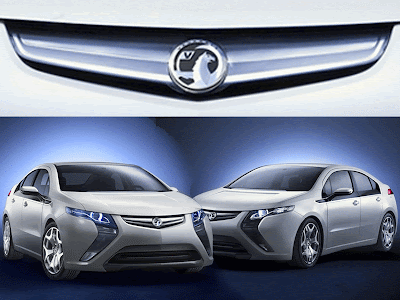
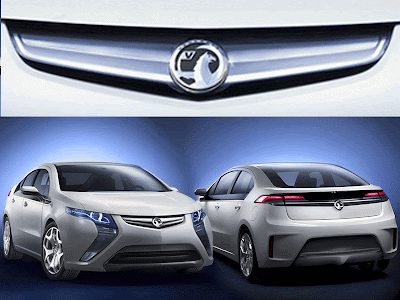
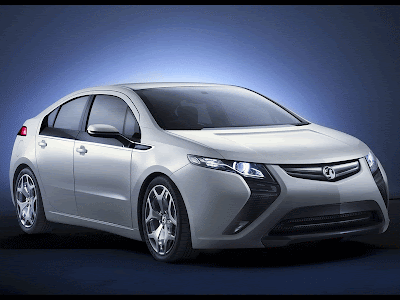
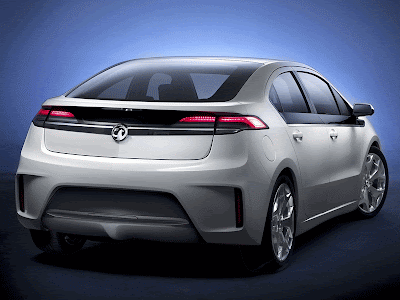
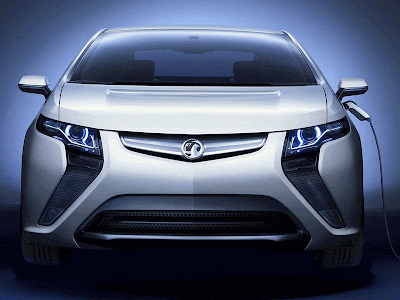
2011 Opel Vauxhall Ampera Plug-in Hybrid

The most enlightening spy photos of the production version of the 2011 Opel Ampera plopped in our inbox today. At first we thought it was just the concept model out testing, but a closer look at the completely undisguised Ampera with the German license plates revealed that this is the actual production model that's due to go on sale in Europe and the UK (as a Vauxhall) in late 2011.
2011 Opel Vauxhall Ampera Plug-in Hybrid
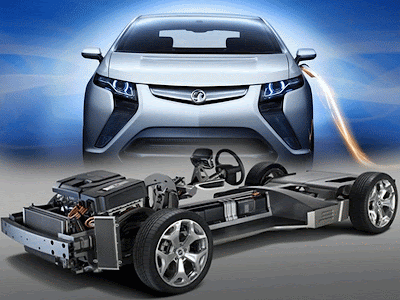
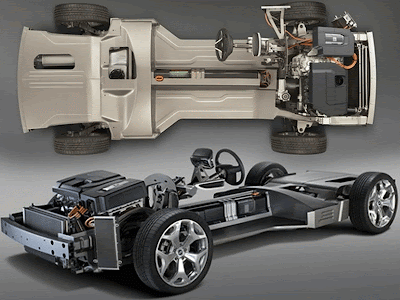
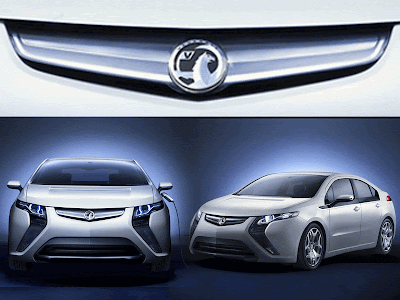
Vauxhall Ampera will be unveiled along with Vauxhall Meriva compact MPV at the Geneva Motor Show 2010. Vauxhall Ampera, schedule for production late next year, is a five-door four-seater with same design DNA as Astra and the Car of the year-winning Insignia. Ampera uses extended-range electric vehicle (E-REV) technology. E-REV uses electricity as its primary power source, supplemented by a small engine to generate electricity for its motors when electric power runs low. This helps the Ampera overcome the ‘range anxiety’ issues associated with pure electric cars.
2011 Opel Vauxhall Ampera Plug-in Hybrid
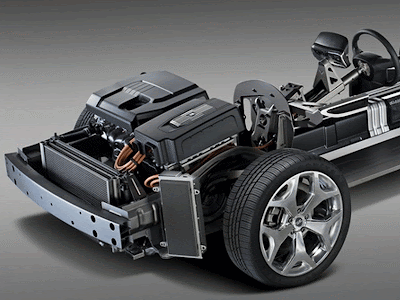
Unlike other conventional propulsion systems, E-REV uses electricity as its primary power source, supplemented by a small engine to generate electricity for its motors when electric power runs low. This helps the Ampera overcome the ‘range anxiety’ issues associated with pure electric cars. Vauxhall will unveil not one, but two cars at this year’s Geneva Motor Show on March 2, with world premieres of the all-new Meriva compact MPV and a futuristic concept car, which is set to boost the company’s credentials as a leader in environmental vehicles.
2011 Opel Vauxhall Ampera Plug-in Hybrid
A quick recap of the details we already know, the Ampera will use the same plug-in hybrid gasoline-electric drivetrain as the Volt. It mates a powerful electric motor and a 16-kWh, lithium-ion battery pack to a 75HP 1.4-liter gasoline engine. But unlike conventional hybrids that use gasoline engines to power the wheels when the battery is depleted, the Ampera uses the petrol unit to generate electricity for the electric motor that always drives the (front) wheels. Owners will be able to charge the battery pack with a home outlet and drive for about 64km or 40 miles before the gasoline engine-generator kicks in to extend the Ampera's range to more than to more than 300 miles or 480 kilometers.
2011 Opel Vauxhall Ampera Plug-in Hybrid
Bolstering this message still further at the show will be the groundbreaking Ampera extended-range electric vehicle and Vauxhall’s most economical production car to date, the latest Corsa ecoFLEX.
2011 Opel Vauxhall Ampera Plug-in Hybrid
‘Vauxhall is covering all bases at Geneva,’ said Duncan Aldred, Vauxhall’s Managing Director. ‘With the Meriva, we have a unique and innovative take on family motoring, but the concept car and Ampera prove that we are truly at the forefront of environmental technology. These vehicles also show that their versatility and efficiency doesn’t come at the expense of stunning design.’

2010 Opel Flextreme GT/E Concept with E-REV Drive System

Think of the Opel Flextreme GT/E concept as a bigger Chevrolet Volt (or Opel Ampera if you're European). The idea behind this concept, which will debut at the Geneva Motor Show (March 4 - 14, 2010), is to show how the Volt's extended-range electric vehicle drivetrain can be used in a larger vehicle, in this case a mid-size five-door hatchback. And it will boost the company's credentials as a leader in green technologies, offering expressive design with efficient environmental performance - and engineered with German precision.
2010 Opel Flextreme GT/E Concept with E-REV Drive System
In Opel's strategy for achieving more independence from fossil fuels, electricity plays a key role. The 4.7-meter long Opel Flextreme GT/E Concept illustrates how extended-range electric vehicle (E-REV) technology can be plugged into large or mid-size vehicles, as well as compact cars such as the upcoming Opel Ampera. Opel calls this strategy e-mobility unlimited: adapting the highly efficient E-REV drive system - which removes the limitations of battery-only power - to vehicles across all market segments. To enjoy zero CO2 driving emissions Opel-style, the Flextreme GT/E concept shows that size doesn't matter.
2010 Opel Flextreme GT/E Concept with E-REV Drive System
The purposeful design also enables the Opel Flextreme GT/E Concept to achieve a projected drag co-efficient of just 0.22, which helps it reach a 200 km/h-plus top speed as well as conserve energy and extend its driving range. Stand-out visual features include a low and wide stance, wing-shaped lights front and rear, a distinctive nose and grille, floating C-pillars and muscular, sculptured bodywork.
2010 Opel Flextreme GT/E Concept with E-REV Drive System
The clean, frontal styling features a low hood line and an extended nose section, which is clasped by wing-shaped, signature LED headlamps. These are deeply carved into the front fenders and across the hood line. The new trapezoidal grille execution is slim but bold. The prominent wing-shaped chrome bar carries a large Opel emblem, which doubles as a socket for charging the Opel Flextreme GT/E Concept's battery pack. The upper section of the grille is used to admit cooling air, the lower portion being covered by a translucent panel. The absence of additional air intakes allows a low frontal area for aerodynamic efficiency and also enables the Opel Flextreme GT/E Concept to meet future pedestrian protection requirements.
2010 Opel Flextreme GT/E Concept with E-REV Drive System
In profile, the Opel Flextreme GT/E Concept is distinguished by innovative, stubbed C-pillars. This floating design allows the glasshouse to be extended rearwards under the arching roofline, emphasizing the flowing lines of the side body. The car's dynamic character is further underlined by a fresh expression of Opel's signature blade motif, now a swooping swage line from the base of the C-pillar into the lower front fender. The translucency of the fixed glass panel in the center of the roof is adaptive, allowing sunlight to warm the interior in the cold of winter, but darkening for coolness in summer. A duct at the rear edge of the roof is for additional cooling of the battery and electronic components.
2010 Opel Flextreme GT/E Concept with E-REV Drive System
Integral to the Opel Flextreme GT/E Concept's expressive looks is the efficiency of the design execution. The small frontal area, low roof height (1308 mm) and a flat, enclosed underbody all enable the car to cleave the air with a minimum of disturbance. The 21-inch alloy wheels are relatively narrow, to reduce wind resistance, and fitted with 195/45, low rolling resistance tires. Clear, flush-mounted trim inserts also minimize air turbulence.
2010 Opel Flextreme GT/E Concept with E-REV Drive System
The Opel Flextreme GT/E Concept also explores the potential for active shape shifting. At speeds above 50 km/h, a vertical panel extends along the body from the air extraction slot behind each rear wheel-arch. These 350 mm-long side spoilers guide high-speed airflow around the rear corners of the car, further reducing the amount of turbulence.
2010 Opel Flextreme GT/E Concept with E-REV Drive System
Mass reduction measures for the body include the use of lightweight, carbon composite outer panels, polycarbonate window glazing and aluminum alloy structural components. Compared to conventional materials, these offer a 40 percent weight saving which further contributes to reduced energy consumption and an increased driving range.
The efficient concept also includes GM's ground-breaking E-REV drive system, already developed for the Opel Ampera. The Opel Flextreme GT/E Concept shows the versatility of this technology by displaying it in a larger, mid-size vehicle format.
2010 Opel Flextreme GT/E Concept with E-REV Drive System
Despite its greater size and a maximum speed of more than 200 kilometers per hour, the Opel Flextreme GT/E Concept is projected to offer performance similar to that of the Ampera: a battery-powered driving range of up to 60 km - with zero CO2 tailpipe emissions - and a total range of more than 500 km. Average fuel consumption is estimated at 1.6 l/100 km, with CO2 emissions of less than 40 g/km. Unlike a hybrid vehicle, the wheels of the Opel Flextreme GT/E Concept are powered at all times by electricity. For typical journeys up to 60 km, energy is supplied by a T-shaped lithium-ion battery pack located under the floor and rear seat.
2010 Opel Flextreme GT/E Concept with E-REV Drive System
However, unlike a battery-only electric vehicle, the Opel Flextreme GT/E Concept eliminates any possibility of range anxiety through fear of being stranded without power. The small gasoline engine/generator is seamlessly engaged to provide electricity whenever the battery's supply becomes depleted. In this mode, the driving range is extended to more than 500 km, until the plug-in battery pack can be recharged or the car is refueled. The motor in the electric drive unit delivers a substantial 370 Nm of instant torque, giving lively performance and projected zero to 100 km/h acceleration in less than nine seconds.
2010 Opel Flextreme GT/E Concept with E-REV Drive System
The Flextreme GT/E concept is a further step in Opel's unfolding strategy for the electrification of the automobile, which includes a wide portfolio of products using battery, extended-range, hybrid and fuel cell technologies.

Opel Derived and Inspired!

The news is just coming out that Buick's Regal will be making a return to the brand's line up. Produced by GM from 1973 to 2004, the Regal was at one time one of the best selling Buicks, offered in two and/or four door body formats. The most well known iteration of the Regal was the Grand National, a stock car that won several titles in the 1980s.

GM has been considering reviving the Regal name for some time. The company is turning to its European division, Opel, to produce the Regal, a model currently sold in China. Right now the Opel Insignia is sold across much of western Europe, thus GM is expected to offer a Buick version of that car by swapping out its grill and replacing Opel badging with Buick.


First introduced for the 2008 model year, the Insignia has been a success for Opel. Replacing the Vectra, the Insignia is stylish, luxurious and very comfortable. Sold as a four door sedan, five door hatchback and a wagon, the Insignia seats five passengers. Only the sedan version will be sold in the US.

Like so many European vehicles, the Insignia has numerous engine choices, nine to be exact. Gas and diesel engines ranging from 1.6L I4 to a 2.8L turbo-charged V6 are available. Likely, a larger in-line four and one or two V6 powered engines will be offered with the Insignia. Unfortunately, no diesel option will be available, given the cost of meeting stringent US pollution requirements.

Though US specifications for the new Regal have yet to be announced, we know that the same six-speed manual and automatic transmissions offered in Europe will be paired with the engines sold in cars in the United States. Furthermore, given that Buick is an upscale brand, leather seating surfaces, navigational controls, wood and aluminum inlays and dual zone air conditioning will either be standard features or packaged optionally.

GM has been looking at separating Opel from its operations, possibly selling off the brand or at least a share of it. That may not affect the Regal as whatever agreement is reached would likely include a long lasting supply chain for Buick's operation. Moreover, the car is sold in Brazil as the Chevrolet Vectra in the UK as the Vauxhall Insignia and will soon be sold in Australia as a Holden model. Clearly, the Regal is coming back. Perhaps as early as this fall in the form of a 2010 model.

Article Source: http://EzineArticles.com/?expert=Matthew_Keegan

Opel's Antwerp plant to close, trade union says

General Motors plans to close Opel's Belgian plant with the loss of more than 2,300 jobs, a German trade union official said Thursday, as workers blockaded the factory parking lot in protest.

Franco Biagiotti, the head of the employee council at the German Bochum plant, told the DAPD press agency that the head of Adam Opel GmbH, Nick Reilly, had said this week that the Antwerp plant would close.

Opel had no comment on speculation that it would announce the closure later Thursday.

Workers in Antwerp occupied the factory's parking lot in protest at the possible job losses, telling reporters that cars would be "kept hostage."

Local press reports say the plant's management will hold a meeting Thursday to discuss the future of the factory.

The fate of the Antwerp plant has been uncertain for some time. When General Motors Co. planned to sell its European car making unit to Canada's Magna and Russia's Sberbank last year, the bidders said they would close it down. GM later decided against selling its European business.

German daily Welt reported Thursday that most of Antwerp's Astra production is to be transferred to the plant in Bochum, citing anonymous sources from the worker council.

Opel said in 2007 that it would stop making the Astra at Antwerp and would possibly replace it with midsize Chevrolet models or sports utility vehicles -- heavier cars that now find few buyers as cash-for-clunkers programs and cash-strapped customers favor more fuel-efficient cars.

Belgium's De Standaard newspaper said GM would lay out details of restructuring for all European factories at a Jan. 28 meeting with unions.

The Belgian government has tried to stave off the Antwerp plant's closure by earlier this year offering the company up to euro500 million ($707 million) to upgrade the facilities.

Opel Insignia OPC Sports Tourer


Post by: Automotive

- Top power: High performance station wagon must complete 10,000 km on Nürburgring
- Top package: 325 hp, 435 Nm, Adaptive 4x4 and 1530 liters load capacity
- Top points: Insignia OPC sedan testing passed with flying colors

Rüsselsheim/Nürburgring. The Insignia OPC Sports Tourer will hit dealerships later this year, but first it has to go through hell – the Green Hell of the Nürgurgring's Nordschleife, considered the toughest, most demanding and dangerous race track in the world.

Opel engineers insist that all vehicles in their OPC range complete a rigorous 10,000 kilometer testing around the 20.8 km Nordschleife of the Nürburgring, dubbed the Green Hell by legendary race car driver Jackie Stewart. Just a few days ago, the Insignia OPC sedan finished the challenge with no problems.

“The Insignia OPC sedan raced 487 laps for 12 days at some top speeds flawlessly. This kind of performance and quality is what we expect from all our Opel cars,” says Hans Demant, Managing Director of Opel.

The Opel Insignia OPC Sports Tourer boasts a 325 hp/239 kW, 435 Nm 2.8-liter V6 Turbo engine for maximum power. It features high-tech elements, like a lower, reworked mechatronic chassis with FlexRide, an Adaptive 4x4 transmission with an electronic rear limited slip differential (eLSD) and purpose-built Brembo brakes – all complemented by spacious station wagon functionality with 1530 liters of load capacity.

Automotive technology at its best

Like the Insignia OPC sedan, the Sports Tourer is full of technological highlights. The OPC engine is 25 percent more powerful than the 260 hp version of the 2.8 V6 Turbo in the Insignia Sport and Cosmo. The increase in power was obtained by reworking the exhaust, significantly reducing the counter pressure, with special mufflers contributing to a sporty, deep sound. The unit comes with a six-speed manual transmission, enabling acceleration from zero to 100 in 6.3 seconds and a top speed of 250 km/h (restricted).

The management unit of the Adaptive 4x4 with eLSD has been recalibrated to adapt torque distribution to the sporty philosophy of the OPC. Engineers at the Opel Performance Center developed a specific high-performance front axle called HiPerStrut (High Performance Strut) for the chassis, which is 10 mm lower than the AWD Insignia Sport version. Benefits include reduced steering disturbances and an improved handling feel for the driver.

The OPC's standard electronic FlexRide suspension has been adjusted for extra performance and caters to those enjoying a sportier ride. It offers three different sporty choices: The standard mode provides its most comfortable ride, a Sport mode is stiffer and a new OPC setting brings optimal fun.

Tough Track: 12 days, 27,000 gear shifts, 35,551 curves and 487 laps

Before it hits the roads in the fall, the new Opel Insignia OPC Sports Tourer will take its turn against the Green Hell: 10,000 fast kilometers on the Nordschleife translates to around 180,000 kilometers on the road. Modified tuning accommodates the station wagon's shifted center of gravity, which is why the Sports Tourer suspension will be tested separately on the Ring.

Even though the 20.8 kilometer, extremely demanding track is part of the standard OPC program, this extra validation is always something special for Volker Strycek and his team. The ex-German Car Championship driver and Manager of the Opel Performance Center sums up: Twelve drivers, Opel design engineers and Nordschleife connoisseurs trade off behind the wheel of a production Insignia OPC for 12 days, rain or shine. “It really can take a toll on a those 12 days add up to 27,000 gear shifts along 35,551 curves during a total of 487 laps.”

Validation Coordinator Jens Hornischer, who drives a major part of the endurance test distance, says, “We push the car to give a constant 90 percent or so – and that is really a tough test for any car. And there is next to no preparation work.”

An Arden Blue Insignia OPC sedan completed its rite of passage earlier in May, confirming the high quality standard that Opel customers expect.

Opel's long tradition of sport station wagons offers best of both worlds

The Insignia OPC Sports Tourer is the latest chapter in a long station wagon success story. As a pioneer in this segment, Opel brought the Olympia Rekord Car-A-van, a combination of car and van, to Europe in 1953. In 1970 Opel built the Ascona Voyage, the first lifestyle station wagon.

The next innovation in this segment followed in 1991, when Opel presented the most powerful production station wagon in the world, the Omega Caravan 24V, a 3-liter, straight-six cylinder with 204 hp. The Vectra OPC continued the Opel tradition of powerful station wagons. It was available from 2005, ultimately as a high-performance front-wheel drive model with 280 hp.

The new 325 hp Opel Insignia OPC takes a huge step forward in terms of driving dynamics with even more power and the Adaptive 4x4 system. And the dynamic Sports Tourer version is also bound to turn heads.

OPC: At home on the Nordschleife

Opel testing on Nürburgring's Nordschleife has a long tradition dating back to the 1960s and sealed when the German brand signed a partner contract with the legendary race track in 2006. It was then that the Rüsselsheim automaker opened its own test center directly at the Ring. The venue offers ideal testing conditions, particularly for Opel's OPC models.

The current high-performance model portfolio includes the Corsa OPC, Astra OPC, Meriva OPC and Zafira OPC in addition to the Insignia OPC notchback, hatchback and Sports Tourer. While the special “Nürburgring Edition” model of the Astra OPC honors the demanding race track, the Astra “OPC Race Camp” pays tribute to the second season of a wildly successful race driver casting.

The OPC Race Camp offer ambitious drivers with no motorsport experience the opportunity to discover their motor racing talents through a rigorous talent scouting process and numerous qualification stages. Those who have the necessary abilities then receive professional instruction to hone their skills and prepare them for competitive motor racing. Opel provides the professional training, cars and necessary organizational support for the Race Camp. Currently 750 candidates from a total of 22,000 applicants are undergoing the training and elimination process led by former race drivers and Opel brand ambassadors Manuel Reuter and Joachim Winkelhock. All hope to land one of the 10 coveted spots on the driver team for the two Astra racing cars that participate in the 24-hour race on the Nürburgring next year.

source : Opel Press

Opel Astra


Post by: Automotive

Opel Insignia Sports Tourer


Post by: Automotive

Opel Astra 2010: ¡Primeras Fotos!


Hola Tuners! Hoy estamos aqui para que conozcan como será el Opel Astra 2010. Es por eso que les presentamos las primeras fotos oficiales entregadas por Opel. Veanlas y disfruten de ellas.


Perfil agresivo de este increible Opel que va a estar presentandose en el salon de Frankfurt durante Septiembre.


Diseño admirable de este Opel Astra cuyo inspirador es su hermano mayor el Opel Insignia.


Nueva Carroceria para este Opel Astra que veremos en las calles en 2010.


Butacas de cuero para los más exigentes.


El mayor desafio de este modelo fue el interior. Opel declara haber solucionado uno de los problemas más comentados entre los clientes, que es el no poseer en el habitáculo lugar para porta-objetos. Es por eso que en este nuevo Opel Astra hay espacio para dejar los anteojos, un contenedor de 9 cds, 2 portavasos y guanteras de amplia capacidad.


En cuanto a las motorizaciones este Opel debutará con una amplia gama de motores a gasolina que arranca con el 1.4 litros naturalmente aspirado al que siguen dos nuevos 1.4 turbo de 120 CV y 175 Nm de torque y otro de 140 CV y 200 Nm de torque para llegar al potente 1.6 litros turbo de 180 CV de los modelos Insignia.

En la gama Diesel encontramos los 1.3 y 1.7 CDTI, luego vendrá el nuevo motor 2.0 litros de 160 CV y para el 2010 se espera la variante EcoFLEX.


Además durante el 2010 se presentarán dos versiones de carrocería, la Sport Tourer y el GTC.


Saludos Tuners!


La gente de Tuning Extremo, Pasión por las 4 ruedas.

Opel Insignia OPC: ¡Versión Tuning!

Hola Tuners! Hoy les presentamos el nuevo Opel Insignia OPC que será presentado el próximo 7 de Mayo en el Salón de Barcelona. ¿De qué se trata? Se trata de la variante tuning del Insignia y estará equipado con un motor V6 2.8 Turbo, el mismo que usa el tope de gama, pero adaptado y mejorado para obtener mayor potencia.

Esta versión del Insignia estará equipada de fábrica con tracción integral (Adaptative 4×4) y diferencial electrónico(eLSD). Como no podia ser de otra manera la suspensión ha sido rebajada en unos 10mm y cuenta con tres modos de configuración(sistema FlexRide) Normal, Sport y OPC Mode y es del tipo Mc Pherson en la parte delantera. El sistema de frenos es Brembo con discos perforados de 335mm adelante.

Opel también incorpora nuevos paragolpes delanteros y traseros, doble salida de escape cromada, alerón trasero, tomas de aire en el paragolpes trasero, llantas de 19 pulgadas y de 20 pulgadas como opcional. Asientos Recaro, volante de cuero de tres rayos. Claramente este Opel puede llegar a ser una base increible para un Tuning Extremo.


El motor es un V6 2.8 Turbo con una potencia de 325CV (65CV más que la versión tope de gama), par máximo de 400Nm(65Nm más que la versión tope de gama) y trabajará en conjunto con una transmisión manual de 6 velocidades. Acelera de 0 a 100Km/h en 6 segundos y alcanza una velocidad máxima de 250Km/h limitada electronicamente.


Saludos Tuners!

La gente de Tuning Extremo, Pasión por las 4 ruedas.


¿Quieres más chicas Tuning? Aqui las tienes: VER MAS!

Official: Opel Insignia OPC technology revealed


The new Insignia VXR from Vauxhall (a.k.a. Opel Insignia OPC), which comes with a total of 325hp, a complex 4-wheel drive chassis and a sprint rate from 0-60mph in under six seconds, is ready to be introduced to the mid-size performance saloon market when it becomes available for sale early this summer.


The new adaptive 4-wheel drive system with an electronic limited slip differential, which provides the Insignia OPC...sorry, the VXR, with plenty of grip and a smooth transfer of power from the drivetrain to the bespoke chassis to the road. The chassis was developed with testing at the Nurburgring track in Germany and lets the VXR sit 10 millimeters lower than the SRi Insignia. The HiPerStrut front suspension keeps torque-steer down and pushes the load back to maintain cornering grip in both wet and dry conditions.


At the core of the Insignia VXR is the advanced 2.8-liter V6 Turbo ECOTEC powerplant from Vauxhall, with a crank made from micro-alloy forged steel, typical 60-degree cylinder angle and die-cast alloy oil sump, features that exist in many racing powerplants. The engine can generate 325PS (up by 65PS compared to the Elite V6) utilizing a single, twin-scroll turbocharger and adaptable valve control for speeding throttle reaction, and has a sprint rate of 0-60mph in just 5.8 seconds, and a maximum electronically limited speed of 155mph. The Insignia VXR’s design was inspired by the Vauxhall/Opel GTC with many of it styling cues familiar to those who have seen the groundbreaking concept at the Geneva in 2007.


The Insignia VXR will come as a 4-door sedan, 5-door hatch or Sports Tourer model.

Pricing details are not yet available.

So, let the British feel good that the Vauxhall marque is still around. Sure, go ahead.

more detail. ...


Other article:
Spy Photos: Opel Insignia OPC in Blue - Clearest
Spy Shots: Fiery new Insignia VXR uncovered
Geneva preview: Opel Ampera Spied Completely Uncovered
Vauxhall's hot new Insignia performance car previewed by Opel OPC
Vauxhall Ampera Confirmed for UK by General Motors
Opel Insignia Leaked